
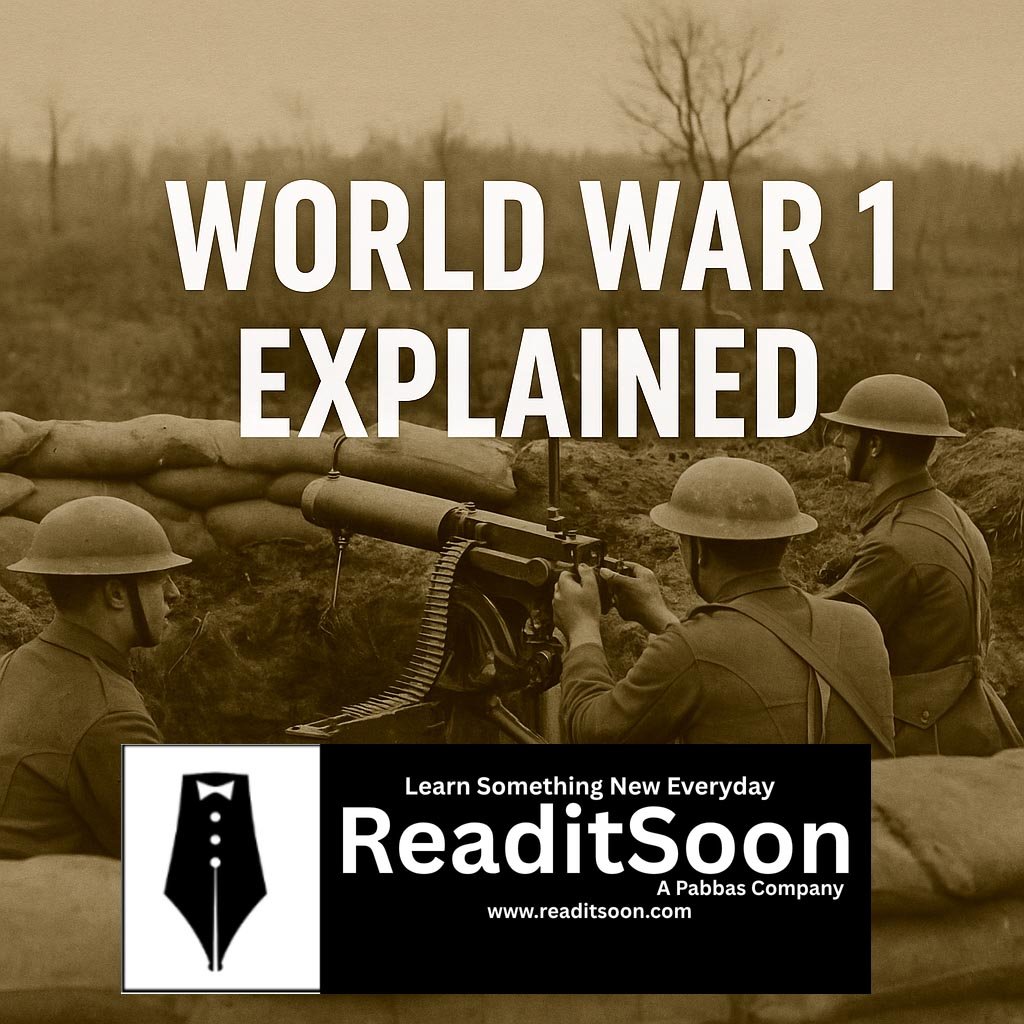
🪖 World War 1 – 25 Simple Questions and Answers You Must Know
By ReadItSoon – Learn Something New Every Day
📘 Introduction
World War 1, also called The Great War, was one of the biggest and most tragic wars in history.
It changed countries, created new ones, and even affected India in many ways.
Let’s understand this historic event through simple, clear questions and answers.
1. What was World War 1?
It was a huge war that happened from 1914 to 1918. Many countries around the world fought in it — mostly from Europe — but people from colonies like India also took part.
2. Why did World War 1 happen?
There were many reasons:
-
Countries were building big armies (militarism).
-
They made secret friendships (alliances).
-
They wanted to control more land (imperialism).
-
They were very proud of their own countries (nationalism).
The final spark came when Archduke Franz Ferdinand of Austria was killed in June 1914.
3. Who killed Archduke Franz Ferdinand?
He was killed by Gavrilo Princip, a young man from Serbia who wanted freedom for his people. This small event started a big chain reaction leading to war.
4. Which countries fought in World War 1?
There were two main groups:
-
Allied Powers – Britain, France, Russia, Italy, Japan, and later the United States.
-
Central Powers – Germany, Austria-Hungary, the Ottoman Empire (Turkey), and Bulgaria.
5. Did India take part in the war?
Yes! Over 13 lakh (1.3 million) Indian soldiers fought for the British Empire in many countries like France, Egypt, and Iraq.
Around 74,000 Indian soldiers lost their lives.
6. Why did Indian soldiers fight if India was not independent?
At that time, India was under British rule. Indian soldiers fought because they were part of the British Indian Army. Many joined for jobs, pride, or adventure.
7. Where did Indian soldiers fight?
They fought in places like:
-
France and Belgium (Europe)
-
Gallipoli (Turkey)
-
Mesopotamia (now Iraq)
-
Africa and Egypt
Their bravery is still remembered in war memorials around the world.
8. What was trench warfare?
Trench warfare means soldiers fought from deep ditches (trenches) dug in the ground.
They stayed there for months, facing rain, mud, rats, and fear of attack every day.
9. What were living conditions like for soldiers?
Very bad — trenches were muddy, cold, full of insects, and there was very little food or clean water. Many soldiers got sick or injured even without fighting.
10. What kind of new weapons were used?
World War 1 saw modern weapons for the first time —
machine guns, tanks, poison gas, airplanes, and submarines.
It was also the first war where chemical gas was used.
11. What was “No Man’s Land”?
It was the empty land between two sides’ trenches. Soldiers tried to cross it during attacks, but it was full of barbed wire, mines, and dead bodies.
12. What were some major battles?
Famous ones include:
-
Battle of the Somme (1916) – one of the bloodiest battles ever.
-
Battle of Verdun (1916) – lasted 10 months.
-
Battle of Gallipoli (1915) – where many Indian troops fought alongside the British.
13. What was the role of women in the war?
Women started working in factories, offices, and hospitals. They replaced men who went to fight and became nurses and war helpers.
14. What was the role of India’s economy?
India supplied food, clothes, weapons, and money to the British. Many Indian farmers suffered because most grains and materials went to the war.
15. How did the war end?
The war ended on November 11, 1918, when Germany agreed to stop fighting — called the Armistice.
The peace deal was later signed in 1919, known as the Treaty of Versailles.
16. What was the Treaty of Versailles?
It was a peace agreement that punished Germany. It had to pay huge money, give away land, and reduce its army. This made Germany very angry later.
17. What were the results of the war?
-
Around 1.7 crore (17 million) people died.
-
Empires like Germany, Austria-Hungary, Ottoman, and Russia fell apart.
-
New countries like Poland, Finland, and Yugoslavia were born.
18. How did it affect India politically?
After the war, Indians expected more freedom for their help. But the British refused — which led to freedom movements like the Non-Cooperation Movement.
19. What was the League of Nations?
It was a group formed after the war to keep peace in the world. It later failed, but it inspired the creation of the United Nations (UN) after World War 2.
20. What was the role of the United States?
The U.S. joined the war late, in 1917, but helped the Allies win by providing fresh troops and supplies.
21. What were the biggest lessons from World War 1?
That wars bring huge loss and no real winners. It taught the world the importance of peace, diplomacy, and cooperation.
22. What changes came after the war?
-
New technology (airplanes, radio, medical tools)
-
More power for common people and women
-
Big changes in politics and world borders
23. Why did another world war happen later?
The harsh punishment of Germany made people angry. This anger helped Hitler rise to power — leading to World War 2 in 1939.
24. How is World War 1 remembered today?
Every year on November 11 (Remembrance Day), many countries honour soldiers who died. India also remembers its brave soldiers from that time.
25. Why should we learn about World War 1 today?
Because it teaches us how small events can create huge changes.
It reminds us of the value of peace, unity, and understanding — lessons still important for our generation.
📘 Reference:
“The First World War” by Michael Howard
A short, simple, and reliable book for anyone who wants to understand the war clearly.